Faculty of Science (SC), Laboratory of Biochemisry and Genetics of Microorganisms (BGM), Louvain Institute of Biomolecular Science and Technology (LIBST)
Challenges
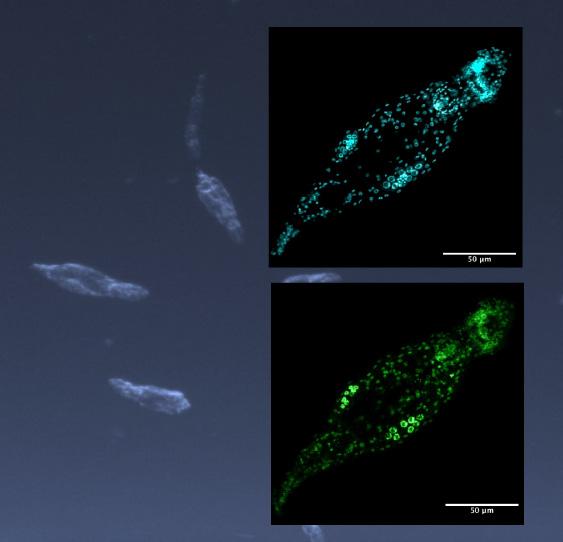
Rotifers may be the smallest known animals on earth but they have exceptional properties. These animals are only female. For tens of millions of years, these animals have thus reproduced without sex. They also have a completely remarkable ability to repair their DNA, making them extraordinarily resistant to chemical and physical attacks. They can survive ionising radiation, tolerating 100 and even 1000x more radiation than humans. Under these conditions, the animal's chromosomes are literally shattered into thousands of pieces. For the first time, our research provides an insight into how rotifers are able to put the pieces of the puzzle back together in order to pass on a correct copy of their DNA to their offspring.
Understanding the mechanisms of resistance to genotoxic stress can be extremely relevant to human biology. DNA damage, or the inability to repair such damage, often lies at the heart of the development of cancer. DNA damage is also a challenge in manned space missions, which expose astronauts to toxic ionising radiation.
UCLouvain’s contribution
As part of his research, Professor Hallet has travelled the world, visiting some of the most remote islands, where he has been able to sample different species of rotifers with very interesting features. His research is situated at the interface between molecular genetics, evolution, toxicology, cancer biology and exobiology. To this end, he is collaborating with the laboratory of Professor Karine van Doninck at the Université Libre de Bruxelles.