Faculty of Science
Challenges
Over the course of their 500-million year evolutionary history, insects have repeatedly forged alliances with bacteria to acquire novel, beneficial functions. This includes the provisioning of nutrients that are absent from their diet: without their bacterial partners, insects are simply unable to survive and reproduce.
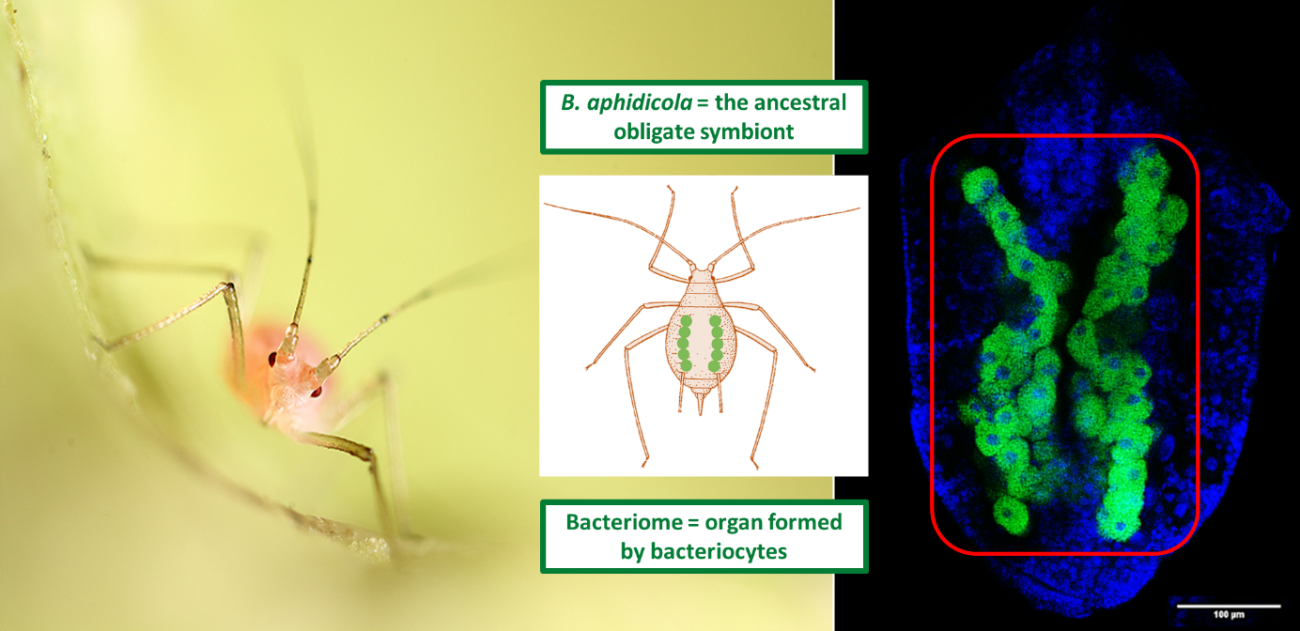
These generally intracellular bacteria colonise specific organs of the insect, and are passed down from generation to generation by parents to their offspring. While this ensures the longevity of the relationship, it also leads to a reductive evolution of these ‘endosymbiont’ bacteria: their genome becomes minuscule and static, giving these bacteria a narrow window of adaptation.
Climate change thus puts host insects at a disadvantage as they are dependent on microbial partners with very little margin for manoeuvre to evolve and adapt to rapid environmental changes.
The aim of this research is to understand how symbiotic relationships between insects and bacteria are formed and break down, particularly in the context of global warming. This is a pressing issue, as rapid warming is accelerating the decline of insects. They owe much of their evolutionary success to relationships with microorganisms that can, however, in the long run also be their undoing.
UCLouvain’s contribution
Endosymbiosis is one of the main driving forces of eukaryotic evolution, resulting in the establishment of mitochondria and plastids, organelles without which eukaryotic life would not be possible. Beyond the challenges of global warming, insects and their endosymbionts are therefore excellent models for deciphering the mechanisms of endosymbiosis and the evolution of life.
This new research at the crossroads of entomology and microbiology will draw on a variety of technical approaches and expertise, spanning several laboratories and institutes at UCLouvain and beyond.