École polytechnique de Louvain (EPL)
Challenges
North-western Europe is protected by kilometres of dikes that protect low-lying areas against flooding caused by high river and sea levels. However, global warming is causing sea levels to rise and increasing the frequency and intensity of flooding. To mitigate the impact of these increasingly severe natural hazards, it is essential to understand the behaviour of these defences under various hydraulic loads, including the effect of water infiltration within the dike, which can significantly reduce its stability.
This knowledge facilitates better prediction of the risk of failure and the extent of flooding, but can also be used as a guideline for the reinforcement and adaptation of these structures by integrating nature-based solutions in their design. Instead of containing the river between concrete embankments, dikes can be moved back and made of natural materials. This facilitates the development of a floodplain, giving the river more space. Such dikes can also be integrated harmoniously into the landscape: some are used as cycle or walking paths along waterways.
UCLouvain’s contribution
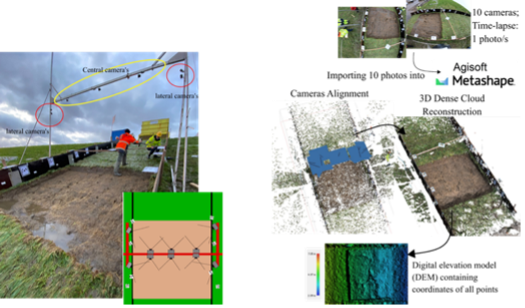
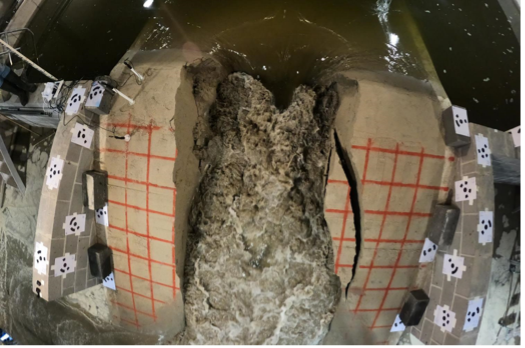
Masoumeh Ebrahimi, a research assistant at UCLouvain, is interested in the phenomenon of common dike failure through breach formation. Although large-scale tests on real dikes are effective for understanding physical processes and predicting failures, small-scale experiments are easier to implement and offer greater flexibility for data manipulation and collection. To better transpose the results of these small models to the real world, she seeks to better understand the dominant physical processes at different scales and quantify scale effect magnitudes in reduced models.
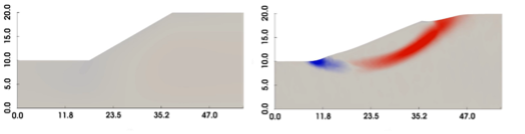
Nathan Delpierre, a PhD student with a FRIA grant, is interested in the digital modelling of dike breaches, and in particular the effect of infiltration of water on the dike. Too much water can cause soil liquefaction, accelerating breaches. By contrast, extreme drought, which is becoming increasingly common, can cause cracks to appear in the surface, creating weak points in the dike. The main challenges for modelling lie in the definition and reproduction of these complex breach evolution patterns.