Faculty of Science
Challenges
Upon atmospheric re-entry, spacecraft are exposed to extreme thermal conditions due to several complex physical phenomena. Their thermal protection system (TPS) consists of a barrier or heat shield to insulate the spacecraft and its payload. The challenge is to design a heat shield, reconciling two constraints: it must be thick enough to protect the spacecraft and payload from extreme heat fluxes while still being as light as possible given that mass is an important factor in space launches.
Currently, large safety margins are applied in the design to address errors and uncertainties relating to the phenomenology of the heat flux and its interaction with the shield. This lack of knowledge results in overdimensioning of the shield or, worse, potential loss of the spacecraft.
A better understanding of atmospheric re-entry phenomena would enable further optimisation of the spacecraft, reducing launch costs in the process.
UCLouvain’s contribution
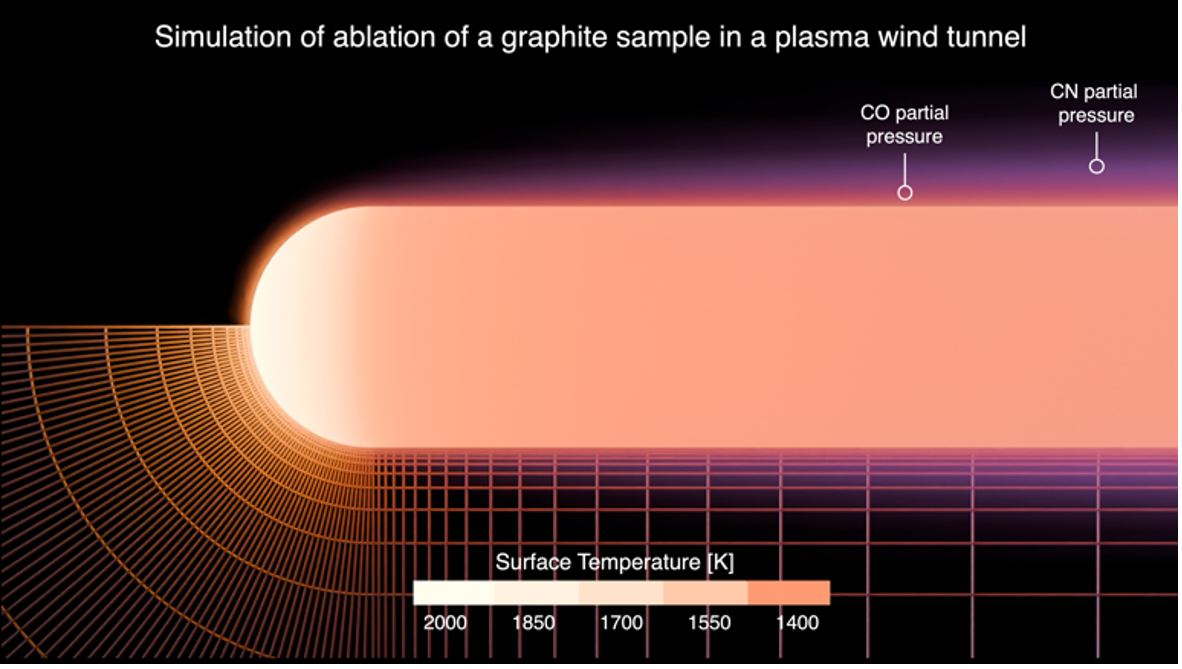
At UCLouvain, Professor Philippe Chatelain is a specialist in aeronautics and fluid dynamics. As part of a collaboration with the Cenaero research centre, the von Karman Institute, and the ULB (Université Libre de Bruxelles), Professor Chatelain is working on advanced digital simulation techniques that reproduce the turbulence, hypersonic shocks, chemical reactions and ablation phenomena to which the heat shield is subjected when exposed to this flux.
These models and simulations contribute to a better understanding of a highly complex phenomenology. This, in turn, leads to improvements in the design of the thermal protection shield and better anticipation of ablation and the resulting temperature increases.